
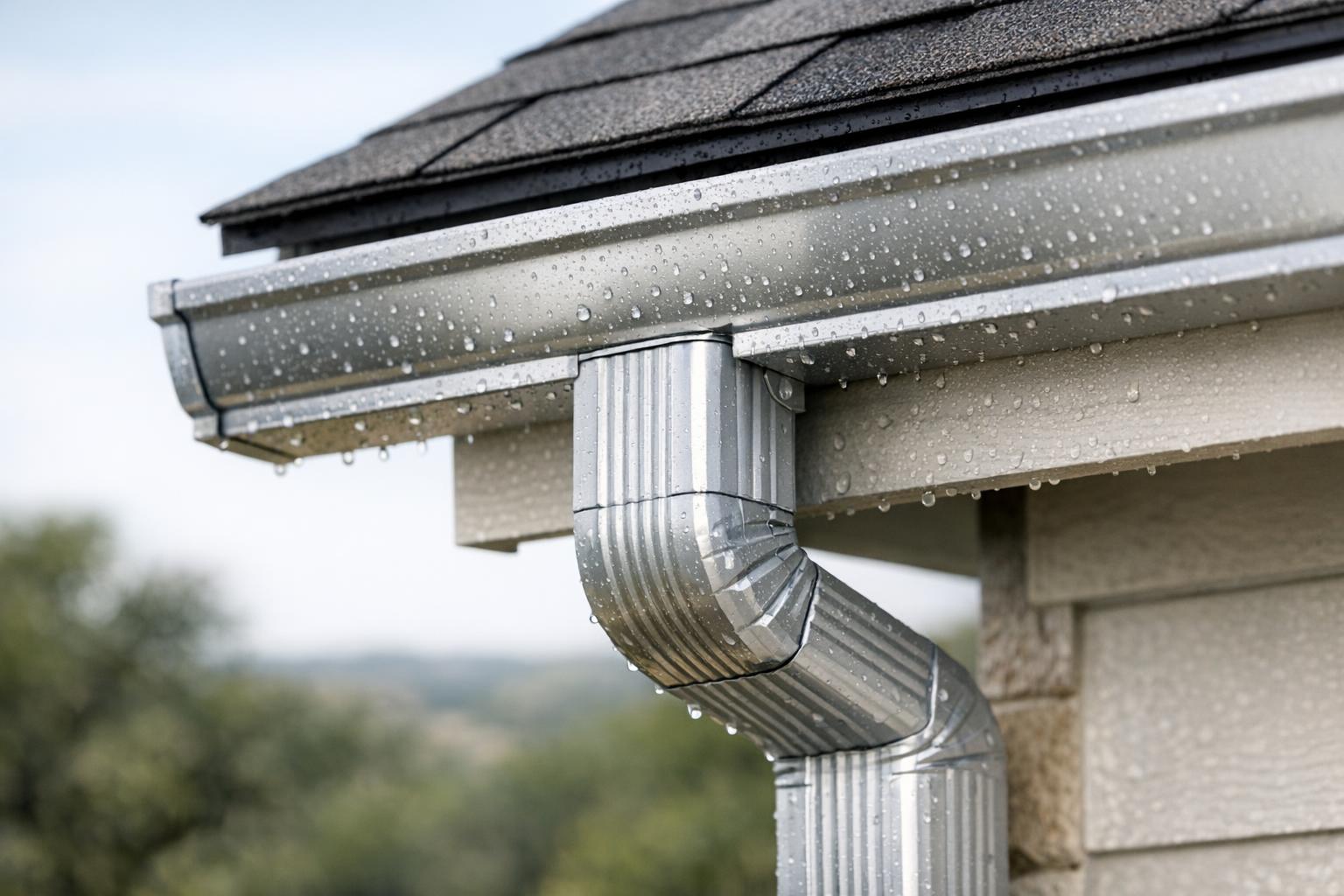
Oversized Downspouts in Texas: When 3×4 Downspouts Are Worth It in San Antonio & La Vernia

Large 3x4 aluminum downspout and gutter on a residential Texas home, designed for heavy rain, with Hill Country landscape in the background.

A smarter way to handle sudden Hill Country downpours

San Antonio and the surrounding Hill Country can swing between long dry stretches and intense, fast-moving storms that dump a lot of water in a short time. Those “burst” rain events are exactly when gutters fail—overflowing over the edge, shooting water past clogged elbows, or backing up into fascia and soffit. One of the most practical upgrades for the right home or building is an oversized downspout (typically moving from a standard 2×3 downspout to a 3×4). It’s not about overbuilding—it’s about giving roof runoff a smoother, less restrictive exit so your gutter system can actually perform when it matters.

What “oversized downspouts” means (and why Texas homes ask for them)

Most residential gutter systems around San Antonio use rectangular 2×3 downspouts. An “oversized” setup usually means stepping up to a 3×4 downspout, often paired with 6-inch gutters or installed strategically on high-volume roof sections (valleys, long runs, steep pitches, or areas that collect multiple roof planes).

Why this matters locally: Texas storms can produce extremely high rainfall rates in short windows. During a major 2025 flash flooding event in San Antonio, hourly rainfall approached about 4 inches in a single hour at the airport—an example of the kind of short-duration intensity that overwhelms undersized drainage pathways. 

2×3 vs 3×4 downspouts: the practical differences homeowners notice

A downspout isn’t just a pipe—it’s the “exit lane” for your whole gutter run. When downspouts are too small (or too few), you’ll see overflow even if the gutter itself is large and clean.

Typical capacity guidance: many sizing charts estimate a 2×3 downspout can serve roughly ~400 sq ft of roof area per downspout, while a 3×4 can serve roughly ~650 sq ft (roof pitch and rainfall intensity can change the real-world performance). 

Flow area perspective: a 3×4 downspout has about double the cross-sectional area of a 2×3 (12 sq in vs 6 sq in), which is why it’s commonly recommended where roof sections are larger or storms are more intense. 

Feature
2×3 Downspout (Standard)
3×4 Downspout (Oversized)
Best fit
Many 5-inch gutter systems
Often used with 6-inch systems or high-volume roof areas 
Roof area guidance (typical charts)
~400 sq ft / downspout 
~650 sq ft / downspout 
Clog/backup resistance
Good, but elbows can become choke points
Better “pass-through” for sudden surges and debris
When it’s most noticeable
Average rain events
Short, intense storms; long runs; valleys; commercial roofs
Important detail: An oversized downspout only helps if the system isn’t bottlenecked at the outlet. If a 3×4 downspout is fed by a smaller outlet, you’re still limited at the smallest point. 

Signs your property may benefit from oversized downspouts

If you’re in San Antonio, La Vernia, Boerne, Fair Oaks Ranch, New Braunfels, or nearby communities, oversized downspouts can be especially helpful on homes with big roof planes and fast runoff. Consider 3×4 downspouts (or additional downspouts) if you notice:
Common red flags:
• Water spilling over the gutter edge during heavy rain even after cleaning
• “Waterfall” effect at corners, valleys, or near the middle of long runs
• Erosion marks under downspout exits or puddling near the foundation
• Downspouts that gurgle, surge, or back up at elbows
• Recurring clogs—especially where leaf guards weren’t designed for your roof/trees
Also keep in mind: not every “overflow” problem is a downspout size issue. Improper gutter pitch, loose hangers, crushed downspouts, or outlet restrictions can create the same symptoms.

Did you know? Quick facts that help you choose the right setup

A 3×4 can move a lot more water
By cross-sectional area, 3×4 downspouts are about double a 2×3, which is why they’re often chosen for big roof sections and heavy downpours. 
More downspouts can beat “bigger”
In many layouts, adding a downspout (reducing the distance water must travel) can improve performance as much as upsizing. 
Outlet sizing matters as much as the downspout
A small outlet feeding a larger downspout creates a choke point and can cut real-world flow. 

How S & H Seamless Gutters approaches sizing (without guessing)

The goal is simple: move water off the roof, through the gutter, and away from the foundation—without overflow during peak rainfall.

When we evaluate whether an oversized downspout makes sense, we look at:

Key sizing and performance checks:
Roof drainage area per section (not just total square footage)
Roof pitch and valleys (steeper/valleys deliver faster, concentrated flow)
Gutter size and outlet size (avoiding bottlenecks at the drop) 
Downspout count and placement (shorter “travel distance” helps during surges)
Discharge plan (extensions, splash blocks, or drainage so water doesn’t return to the slab)
If you’re already planning a new system, it’s often the best time to design it correctly—especially if your property has long gutter runs, multiple roof planes draining to one corner, or history of overflow during hard rain.

Local angle: San Antonio, La Vernia & Hill Country drainage realities

Even when the region is dealing with drought conditions, San Antonio can still see storms that hit hard when they finally arrive—creating runoff conditions that stress gutters, downspouts, and splash control. Local reporting has also highlighted that hourly rainfall intensity has increased in San Antonio over the long term, which aligns with what many homeowners experience: “less frequent” doesn’t always mean “less intense.” 

For homes in La Vernia and the surrounding Hill Country, other factors also matter:
Soil + foundation concerns
Fast roof runoff dumped at the edge of a slab can lead to erosion, splash-back staining, and moisture near the foundation line—especially where grades are tight.
Big roof sections and long runs
Many Texas homes have long gutter runs and broad roof planes. That layout often benefits from either additional downspouts, oversized downspouts, or both.
Debris patterns vary by neighborhood
Live oaks, cedar, and seasonal shedding can clog screens, outlets, and elbows. The right leaf guard plus proper outlet sizing can prevent recurring backups.
If you’re searching for gutter help in the metro area, you can also see our service coverage here: Gutter Installation & Repair in San Antonio, TX.

Schedule an oversized downspout evaluation (or fix the real bottleneck)

If your gutters overflow during heavy rain, the solution might be oversized downspouts—or it might be a pitch, outlet, hanger, or clog issue. S & H Seamless Gutters can inspect your current system and recommend a practical upgrade plan for San Antonio, La Vernia, and nearby areas.
Request a Free Estimate

Prefer quick mobile contact? Use the form to request a call-back and share what you’re seeing (overflow locations, roof valleys, recent clogs, and any drainage issues near the foundation).

FAQ: Oversized downspouts in San Antonio & surrounding areas

Are 3×4 downspouts always better than 2×3?
Not always. Many homes perform perfectly with 2×3 downspouts when the system has the right number of downspouts, proper pitch, and clean outlets. A 3×4 is most valuable when roof sections are larger, runoff is concentrated, or intense storms cause surging/overflow.
Can I install a 3×4 downspout on my existing gutter?
Sometimes—but it depends on your gutter size and, critically, your outlet/drop size. If the outlet is still 2×3, you won’t get the full benefit because the outlet becomes the choke point. 
Will oversized downspouts stop gutter overflow during extreme storms?
They can significantly reduce overflow when downspout capacity is the limiting factor. But extreme rainfall rates can still overwhelm a system if the gutter is undersized, the run is too long, or water is concentrating in valleys. In those cases, the best fix may be adding downspouts, upgrading gutter size, or reworking placement.
Do leaf guards work with oversized downspouts?
Yes—leaf guards help prevent clogs that can cause backups at outlets and elbows. The guard type should match your roof style and debris load (oaks vs pine/cedar), and the rest of the system still needs correct pitch and outlet sizing.
How do I know how many downspouts I need?
A good starting point is the roof area per drainage section and where valleys concentrate flow. Many sizing charts provide roof-area guidance (for example, ~400 sq ft per 2×3 downspout and ~650 sq ft per 3×4), but pitch and storm intensity can change what your home needs. 

Glossary

Downspout (2×3, 3×4)
The vertical pipe that carries water from the gutter to the ground. “2×3” and “3×4” refer to the rectangular dimensions in inches.
Outlet / Drop
The opening connecting the gutter to the downspout. If the outlet is smaller than the downspout, it can restrict flow and reduce the benefit of upsizing. 
Gutter Pitch
The slight slope of the gutter run toward the downspout. Incorrect pitch can cause standing water, overflow, and premature corrosion.
Roof Valley
The line where two roof planes meet. Valleys concentrate runoff, often requiring more downspout capacity or improved placement.

Related Post

Accessibility Toolbar