- Smart downspout discharge prevents foundation movement, erosion, and surprise puddles
- Why “downspout placement” matters more in clay soil neighborhoods
- Quick answer
- What “good” downspout placement looks like (and what to avoid)
- Helpful comparison table
- Did you know? Quick roof-drainage facts that surprise homeowners
- Step-by-step
- San Antonio + La Vernia local angle
- Get help with downspout placement, extensions, and drainage-friendly gutters
- FAQ
- Glossary (plain-English)
Smart downspout discharge prevents foundation movement, erosion, and surprise puddles
In the San Antonio area and the surrounding Hill Country, clay-heavy soils can expand when wet and shrink when dry. That moisture swing is tough on slabs, walkways, and landscaping. Your gutters collect roof runoff—but downspout placement determines where that water ends up. If it dumps too close to the house (or into a flower bed that holds water), you can get soil saturation at the foundation edge, settlement, cracking, or erosion along the perimeter.
Why “downspout placement” matters more in clay soil neighborhoods
Clay soil drains slowly. When roof water is discharged right beside the home, it can linger and soak the soils near the slab edge. In expansive clay, repeated wet/dry cycles can contribute to foundation movement—especially when one side of the home stays wetter than the others.
The goal is straightforward: collect the water cleanly, move it away fast, and release it where it can keep traveling away (not back toward the house).
Quick answer: how far should a downspout discharge in Texas clay?
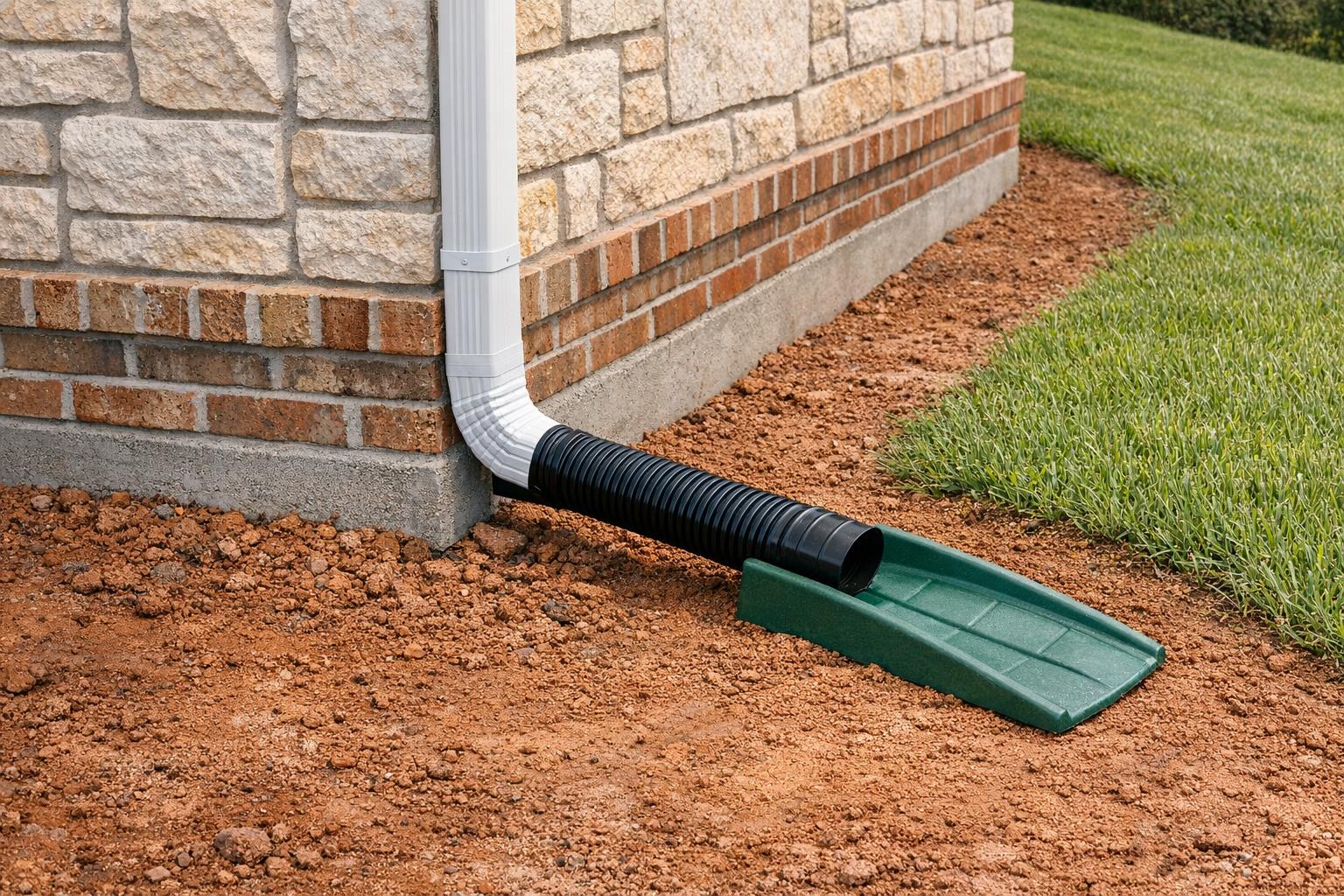
A practical target for many homes is to discharge roof water at least 5 feet away from the foundation, and often farther (8–10 feet) is better when space and drainage paths allow—especially in slow-draining or expansive clay. The real “best” distance depends on slope, soil, landscaping, and where the water can safely exit the property.
Just as important as distance is direction: the discharge should land on grade that continues moving water away, not into a low spot or against a fence line that traps runoff.
What “good” downspout placement looks like (and what to avoid)
Good placement
Common mistakes (very common around San Antonio)
Helpful comparison table: downspout discharge options
| Option | Best For | Pros | Watch Outs |
|---|---|---|---|
| Splash block only | Homes with strong slope away from foundation | Simple, reduces erosion at the exit point | Doesn’t move water far if the yard is flat or clay-heavy |
| Above-ground extension (flexible or hinged) | Most residential homes needing better discharge distance | Fast improvement, low disruption, easy to inspect | Can be crushed by mowing; needs seasonal checks for clogs |
| Buried solid pipe to “daylight” (emits at a safe outlet) | Cleaner look; tight side yards; persistent ponding areas | Moves water farther, keeps yard tidy, reduces erosion near home | Must be sloped correctly; needs cleanouts/maintenance access |
| Drainage system tie-in (approved discharge point) | Certain commercial sites or engineered drainage designs | Highly effective when designed correctly | May require permits/coordination; avoid illegal/unsafe connections |
Did you know? Quick roof-drainage facts that surprise homeowners
Step-by-step: evaluate downspout placement around your home
1) Walk the perimeter after a real rain
Look for overflow lines in mulch, soil washouts, or puddles that hang around near the slab. If water sits along the edge of the home for hours, you likely need a better discharge path and/or improved grading.
2) Check discharge distance (aim for 5+ feet where feasible)
In clay soil areas, many homeowners benefit from extending discharge at least 5 feet away from the foundation edge. If your lot allows it, pushing water farther—while keeping it on a downhill route—often reduces soggy corners and erosion.
3) Confirm water can keep traveling away (grading matters)
A common benchmark is maintaining a slope away from the home (often described as about 6 inches of fall over 10 feet, where practical). If the ground is flat or back-pitched, you may need regrading, a swale, or a properly designed drain run to a safe outlet.
4) Decide: above-ground extension or buried drain line?
Above-ground extenders are quick and visible (good for troubleshooting). Buried lines look cleaner but must be installed with consistent slope and a discharge point that won’t backflow toward the home.
5) Make sure gutters can actually feed the downspouts
If gutters are clogged or pulling away, water will spill over the edge and defeat any “perfect” downspout plan. Cleaning, resecuring, and minor repairs are often the first step before adding new discharge runs.
San Antonio + La Vernia local angle: what changes in the Hill Country region?
Around San Antonio, La Vernia, and nearby communities, you’ll often see a mix of expansive clay, rocky areas, and lots with tight side-yard drainage. That combination creates two frequent issues:
Get help with downspout placement, extensions, and drainage-friendly gutters
If you’re seeing soggy corners, overflowing gutters, soil washout, or water staining on brick and concrete, the fix is often a combination of proper gutter performance and smarter downspout discharge planning. S & H Seamless Gutters serves San Antonio, La Vernia, and surrounding areas with seamless gutter installation, repairs, cleaning, leaf guards, and ongoing maintenance.
Prefer to start with maintenance? Explore gutter cleaning or schedule gutter maintenance & inspection to catch issues before they become repairs.
FAQ: Downspout placement in clay soil (San Antonio area)
How many downspouts do I need?
It depends on roof size, roof layout (valleys dump a lot of water), gutter size, and local rainfall patterns. If you’re seeing overflow at corners or during heavy storms, adding a downspout or upsizing may be part of the solution.
Is a splash block enough for Texas clay soil?
Sometimes, but often not by itself. Splash blocks help prevent erosion at the exit point, but clay soil and flat yards typically need added distance (extensions) and a clear downhill drainage path.
Should downspouts drain into flower beds?
Usually, that’s risky if the bed sits close to the slab because mulch and edging can hold water against the foundation. If landscaping is the only path, consider extending past the bed and discharging onto a graded area that carries water away.
Are buried downspout drains a “set it and forget it” solution?
They’re lower-profile, but not maintenance-free. Buried lines should be installed with proper slope, solid pipe (not perforated for roof runoff), and a cleanout strategy so clogs can be cleared without digging up the yard.
What are warning signs my downspouts are causing problems?
Look for erosion trenches under the outlet, algae lines on siding/brick, puddles near the slab after storms, water stains on concrete, and gutters that spill over in the same spots repeatedly.