Navigation ▼
- Protect your roofline before a small overflow turns into rotten wood and loose gutters
- Why fascia damage is so commonly tied to gutter issues
- Top signs your gutters may be damaging your fascia
- Common causes of fascia damage (and what actually fixes them)
- Step-by-step
- When repair is enough vs. when replacement is smarter
- Local angle
- Stop fascia damage before it spreads behind the gutter line
- FAQ
- Glossary (quick, homeowner-friendly)
Protect your roofline before a small overflow turns into rotten wood and loose gutters
Fascia boards sit right where your roof meets your gutter system—so when gutters clog, pull loose, or overflow, the fascia often takes the hit first. In the San Antonio area and surrounding Hill Country communities, heavy downpours, wind-driven rain, and seasonal debris can push gutter systems hard. This guide explains how fascia damage gutters problems start, what to look for, and which repairs actually stop the cycle (not just cover it up).
Why fascia damage is so commonly tied to gutter issues
Your fascia is the long board along the eaves where gutters are typically fastened. When gutters work correctly, they capture roof runoff and move it to downspouts—keeping water away from the roof edge, trim, siding, and foundation. When gutters fail (clogs, incorrect slope, undersized downspouts, or loose hangers), water can repeatedly soak the fascia, seep behind the gutter, and lead to rot, warping, peeling paint, and fastener failure.
Once fascia softens, gutters can start pulling away, creating bigger gaps and even more overflow. That’s why “just reattaching” a sagging gutter without fixing the underlying fascia and drainage issues often turns into repeat repairs.
Top signs your gutters may be damaging your fascia
Look for these warning signs along the roofline—especially after storms or when you notice overflow:
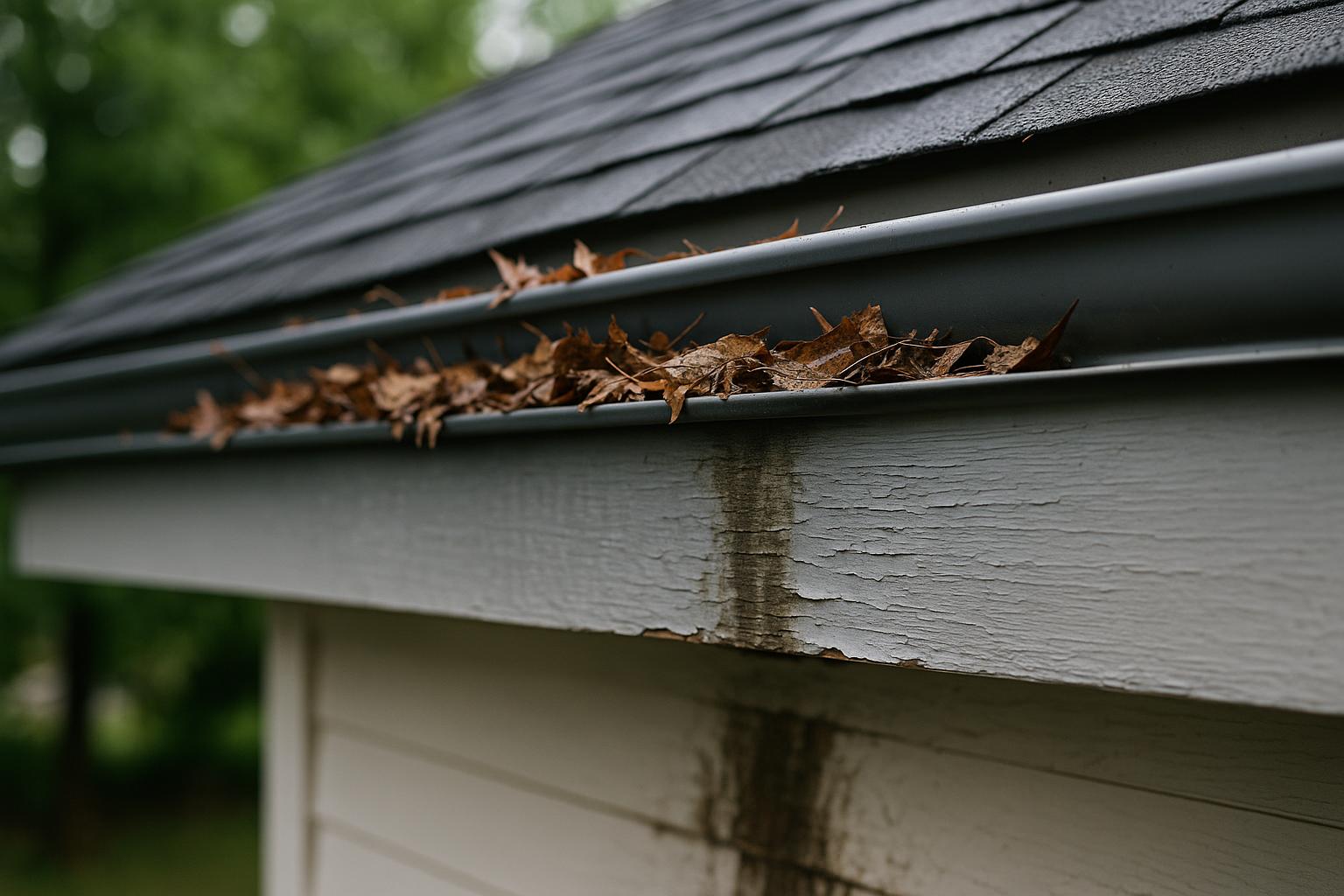
1) Peeling paint, soft spots, or warped boards
Moisture gets behind the paint first, then the fascia begins to soften or deform.
2) Water stains along the roof edge
Brown streaks or staining near the gutter line can point to chronic overflow or water running behind the gutter.
3) Gutters separating from the house or sagging
If the gutter line looks wavy, bowed, or pulled away, the fasteners may be loosening—or the fascia may already be compromised.
4) Overflow during normal rain (not just “once in a while”)
Frequent overflow usually means a clog, poor pitch, too few downspouts, or an undersized system for the roof area.
Common causes of fascia damage (and what actually fixes them)
Fascia damage usually isn’t one single event—it’s repeated water exposure. Here’s how it typically happens and the most practical fix for each.
| Cause | What you’ll notice | Best long-term fix |
|---|---|---|
| Clogged gutters / debris dams | Overflow at the front edge, stains, splash marks, dripping behind the gutter | Professional cleaning + flush downspouts; consider leaf guards in heavy-debris areas |
| Gutters pitched incorrectly (holds water) | Standing water, mosquitoes, persistent drip lines | Re-level / re-hang gutters to correct slope; replace damaged hangers |
| Too few downspouts / undersized drainage | Overflow even when gutters look clean; leaking between gutter and fascia | Add downspouts; evaluate 5″ vs 6″ capacity for roof area and rainfall intensity |
| Loose / failing fascia attachment | Gutter pulling away; visible gaps; sagging sections | Replace compromised fascia; reattach gutters with proper hangers to solid framing |
Step-by-step: how to prevent fascia damage from gutters
If your goal is to stop fascia damage before it starts (or keeps coming back), use this practical checklist.
1) Check overflow patterns after a rain
Walk the perimeter and look for spillover points. Repeated overflow in the same spot usually indicates a clog, a low spot (bad pitch), or a downspout limitation.
2) Clean gutters and flush downspouts (not just the trough)
A gutter can look “mostly clean” but still back up if the downspout has compacted debris. A proper service removes roofline debris and confirms water actually exits the system at full flow.
3) Confirm the system is sized and drained for real rainfall
Intense rain can overwhelm under-built systems. Many pros recommend higher-capacity options (like 6″ gutters in some situations) and reviewing downspout quantity/placement so water can exit quickly.
4) Keep runoff moving away from the foundation
Discharging roof runoff away from the foundation is a durability best-practice referenced in building guidance and code commentary discussions—extensions or proper drainage paths can help reduce saturation next to the home.
5) Address fascia early—before it can’t hold fasteners
If the gutter is pulling away, the fascia may already be too weak to anchor properly. Reattachment without repairing the board often leads to repeat sagging and more hidden water intrusion.
When repair is enough vs. when replacement is smarter
Not all fascia damage requires a full replacement—but some situations do. A professional inspection typically looks at how far rot has spread, whether fasteners bite into solid wood, and whether water is getting behind the gutter.
Repair may be enough when:
The fascia is mostly solid, damage is localized, the gutter can be re-sloped, and overflow is clearly tied to a maintenance issue (like a clog).
Replacement is often smarter when:
The board has soft/crumbly sections, the gutter repeatedly pulls away, or you see ongoing staining and gaps that suggest water is running behind the system.
Helpful next step:
If your gutter is sagging or separating, start with a gutter maintenance & inspection to identify whether the root cause is clogs, pitch, downspouts, or fascia deterioration.
Local angle: what San Antonio & La Vernia homeowners should watch for
South-Central Texas weather can be hard on roof edges: fast, heavy rain bursts; wind that drives water behind gutters; and seasonal debris that can pack into troughs and downspouts. If you’re in La Vernia, TX, San Antonio, or nearby Hill Country communities like Boerne, Fair Oaks Ranch, and New Braunfels, fascia problems often show up after:
• A storm where gutters overflowed in multiple spots
• A season of leaf/seed buildup where gutters weren’t cleaned
• Repeated “minor” leaks at the gutter-to-fascia line that never fully stop
If your home has long roof runs, complex rooflines, or landscaping that sheds debris into valleys, a capacity and drainage review (gutter size + downspout plan) can be especially worthwhile.
Service areas:
Explore local service information for San Antonio gutter installation & repair, plus nearby communities including La Vernia, Boerne, Fair Oaks Ranch, and New Braunfels.
Stop fascia damage before it spreads behind the gutter line
If you’re seeing overflow, sagging, or peeling paint at the roof edge, an inspection can confirm whether you need cleaning, repair, added downspouts, leaf guards, or fascia replacement. S & H Seamless Gutters serves La Vernia, San Antonio, and surrounding areas with professional installation, repair, cleaning, and maintenance.
Related services: gutter repair, gutter cleaning, seamless gutter installation, leaf guard installation, and gutter replacement.
FAQ: fascia damage & gutter problems
How do gutters cause fascia damage?
When gutters clog or can’t drain fast enough, water overflows and repeatedly wets the fascia. Water can also run behind the gutter if the gutter is separating from the roof edge. Over time, the fascia can rot/warp and lose its ability to hold gutter fasteners.
What’s the fastest way to tell if fascia is rotting?
Peeling paint, visible warping, dark staining, or soft spots when gently pressed are common indicators. Sagging gutters can also be a clue that the fascia behind the hangers is no longer solid.
Why does water leak between the gutter and fascia even when gutters look “clean”?
Common causes include too few downspouts, undersized gutters, incorrect slope, or separation that lets water run behind the gutter line.
Should I install leaf guards to prevent fascia damage?
Leaf guards can reduce debris buildup and the frequency of clogs—especially in areas with heavy leaf drop or roof valleys that funnel debris. They’re most effective when paired with correct gutter sizing, good pitch, and properly placed downspouts.
If my gutter is pulling away, can it just be screwed back in?
Sometimes—if the fascia and framing are still solid. But if the board is rotted or softened, new fasteners won’t hold for long. A proper repair evaluates the fascia condition first, then re-hangs the gutter with secure attachment points.
Glossary (quick, homeowner-friendly)
Fascia
The board along the roof edge, where gutters are often mounted; it caps rafter ends and helps form a clean roofline.
Soffit
The underside of the roof overhang; helps close the gap under the eaves and often supports ventilation.
Downspout
The vertical pipe that carries water from the gutter down to a safe discharge area away from the home.